
Batteries From Sustainable Materials
Silicon-air batteries promise very high theoretical energy densities, however controlling passivation and corrosion in alkaline electrolytes is key.
Foto: KI-generiert mit OpenAI
Silicon-Air Batteries (SAB): Energy from Silicon and Air
Silicon-air batteries (SABs) are a type of metal-air system and are considered a concept that could enable very high storage capacities in the future. The basic principle is simple: oxygen from the ambient air is used at the cathode, while the anode consists of silicon. This material is not only indispensable in the chip industry but also possesses enormous theoretical potential for energy storage.
Since silicon is widely available as an element, it is also interesting from a raw material perspective to reduce dependencies on critical materials. However, the path from theoretical potential to practical application is challenging because the chemical processes within the battery are complex.
The Challenge: Stable Discharge in Alkaline Solutions
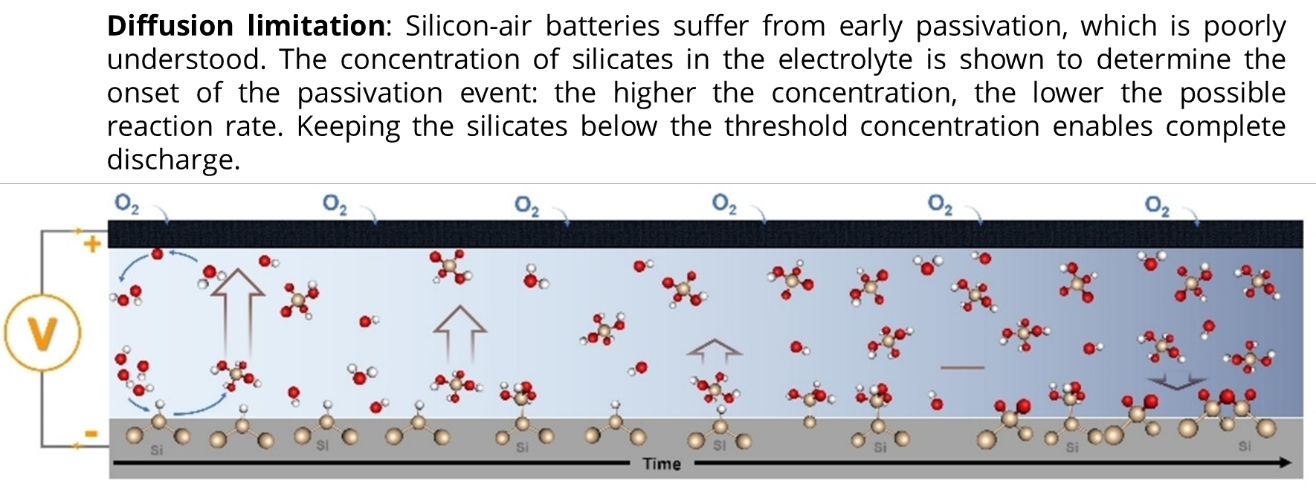
Many SAB concepts use alkaline electrolytes to enable ion flow between the electrodes. A fundamental problem often occurs here: The battery discharge stops prematurely, long before the silicon is consumed. The reason for this is that the silicon surface changes and passivates during the reaction. A layer forms that blocks further electrochemical reaction.
Our research addresses exactly this issue. We investigate the factors that trigger this premature termination. Our results show that an enrichment of dissolved silicon or silicates in the electrolyte plays a crucial role. If reaction products are not transported away from the surface quickly enough, passivation accelerates. A deep understanding of this silicate chemistry is therefore the key to designing electrolytes that allow the battery to deliver energy for longer and more stably.
Increasing Efficiency: The Problem of Corrosion
A second major topic in alkaline silicon-air batteries is so-called parasitic corrosion. In the aggressive environment of the alkaline electrolyte, silicon also reacts chemically without generating usable current. This means that part of the fuel dissolves without contributing to energy generation, significantly lowering the efficiency of the overall system.
To minimize these losses, we are researching special additives for the electrolyte. A promising approach is the partial replacement of water with polyethylene glycol (PEG). Our investigations show that PEG can significantly dampen corrosion and positively influence the etching behavior on the silicon surface. In experiments, we were thus able to significantly increase the usable energy from the amount of silicon consumed.
Current Research Activities:
- Investigation of self-discharge and degradation mechanisms
- Targeted control of chemical side reactions during electrochemical operation
- Development of more efficient electrolyte compositions to minimize passivation effects
References:
- Schalinski, S., Schweizer, S. L., & Wehrspohn, R. B. (2023). The Role of Silicate Enrichment on the Discharge Duration of Silicon‐Air Batteries. ChemSusChem, 16(9), e202300077.
DOI: 10.1002/cssc.202300077 - Schalinski, S., et al. (2023). Inhibition of Corrosion in Alkaline Silicon–Air Batteries with Polyethylene Glycol. Advanced Energy and Sustainability Research, 2300138.
DOI: 10.1002/aesr.202300138