
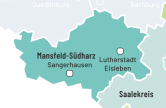
Mansfeld-Südharz
Located on the southwestern edge of Saxony-Anhalt – right on the border with Thuringia – the district of Mansfeld-Südharz combines diverse landscapes with a deeply rooted industrial history. From the Harz Mountains to fertile meadows and the Süßer See, the region offers not only scenic variety but also cultural centers such as Sangerhausen, Eisleben, and Hettstedt. For over 800 years, copper mining shaped the region’s economic and social fabric until its closure in 1990 – a profound turning point for the area. Today, the Amsdorf lignite open-cast mine and the production of montan wax set worldwide standards. At the same time, 27 nature reserves make Mansfeld-Südharz a place full of contrasts – between nature, tradition, and structural transformation.
Several structural and societal areas of tension currently shape the situation in the Mansfeld-Südharz district:
Conflicts of interest in the context of structural change: The “Masterplan Mansfeld-Südharz,” developed by the district administration together with other key institutions, outlines important future questions and potential solutions. Fundamental structural changes in infrastructure, basic materials industries, or the implementation of the energy transition in the region create conflicts that must be resolved jointly with citizens.
Land-use conflicts: Competition between gypsum extraction and the preservation of the karst landscape creates tensions. A similar situation exists between waste incineration and protection against emissions.
Acceptance issues with energy projects: The development of energy supply for regional industrial companies using green hydrogen faces resistance from citizen initiatives.
Demographic challenges: With an average age of 50.3 years, Mansfeld-Südharz is the oldest district in Germany. This affects the labor market and economic development.
Economic transformation: Small and medium-sized enterprises face the challenge of maintaining their competitiveness in a changing economic structure.
Resource utilization: Responsible management of mineral resources, such as mines, spoil heaps, and Theisen sludges, is an important task.
Land-use potential: The region offers ample space for new settlements, which presents opportunities but also creates new conflicts over land use.
To make the district sustainable for the future, the following measures are necessary:
Support for small and medium-sized enterprises through consulting and funding programs.
Balancing climate protection and environmental protection in resource utilization.
Strengthening public acceptance of structural change solutions through transparent citizen participation.
Securing skilled labor and providing training to address demographic challenges.
Sustainable management of mineral resources and industrial legacies.
Development of land-use concepts for new settlements.
Harmonization of political, economic, ecological, and social issues.
Promotion of innovative, future-oriented technologies.
JTC Projects in the Mansfeld-Südharz Region
- Establishment of a teaching and research mine in Wettelrode near Sangerhausen, in cooperation with the city of Sangerhausen
- Cooperation project for education in rural areas between Martin Luther University Halle-Wittenberg (MLU), the Center for Social Research Halle e.V., the Wissensspeicher MSH, and the Adult Education Center of Mansfeld-Südharz (Kreisvolkshochschule Mansfeld-Südharz e.V.) in the municipalities of the Mansfeld-Südharz district
- Support for ROMONTA GmbH in Amsdorf in addressing the challenges of structural change for a lignite-mining and processing company.