The generator makes administration easier, faster and more user-friendly.
In government administration, we face bureaucracy that our AI-powered grant guideline generator is designed to tackle. No more mountains of paperwork and unnecessary administrative burdens—this makes the creation of guidelines future-proof and efficient. For the state of Saxony-Anhalt, this means more than just greater convenience: Funding guidelines that are created, reviewed, and implemented more quickly ensure that approved funds find their way into practice before budgetary deadlines restrict the scope for action. Shorter processing cycles thus ensure that available funds can be used in full and for their intended purpose to the greatest possible benefit of citizens, municipalities, and the region’s development.
We are developing an AI-based guideline generator for Saxony-Anhalt that automates, standardises, and renders transparent the previously time-intensive process of drafting funding guidelines. The no-code application decomposes complex legal texts into clearly structured sub-questions and translates them into a visual flow chart. This chart illustrates decision-making and process steps, thereby providing transparency across workflows and review points.
On the basis of this flow chart, the system generates an adaptive questionnaire. The responses of administrative staff systematically populate the relevant fields, identify potential variations, and generate text module suggestions. The generator then assembles the corresponding modules into a coherent draft guideline. These semi-automated proposals are reviewed and validated by legal experts, ensuring both procedural efficiency and legal accuracy.
weiterlesen
In der Verwaltung bekämpfen wir Bürokratie mit unserem KI-gestützten Förderrichtliniengenerator. Schluss mit Papierbergen und unnötigem Verwaltungsaufwand!
Parallel dazu treiben wir die dringend benötigte Modernisierung der Justiz voran. Unser Prestigeprojekt: die Modellierung eines vollständig digitalen Zwangsvollstreckungsverfahrens in Kooperation mit dem Justizministerium.
Wir verankern die Digitalkompetenz in der Region durch unser Zertifikatsprogramm “Future Legal Education” und bieten mit unserem Lab-Launch-Space auf dem Campus einen kreativen Raum für innovative Ideen. So binden wir Talente an die Region und stoppen die Abwanderung junger Juristinnen.
Unsere internationale Strahlkraft beweisen wir mit dem interaktiven Explorer-Tool für UNCITRAL-Dokumente, das unsere Region als Vorreiterin für innovative LegalTech-Lösungen etabliert.
Team
Dr. Konstantin Branovitskiy, Teamleiter
Liubov Zazulina, Ph.D.
Georgia Könemann
Luzia Ferenschild
weiterlesen
In der Verwaltung bekämpfen wir Bürokratie mit unserem KI-gestützten Förderrichtliniengenerator. Schluss mit Papierbergen und unnötigem Verwaltungsaufwand!
Parallel dazu treiben wir die dringend benötigte Modernisierung der Justiz voran. Unser Prestigeprojekt: die Modellierung eines vollständig digitalen Zwangsvollstreckungsverfahrens in Kooperation mit dem Justizministerium.
Wir verankern die Digitalkompetenz in der Region durch unser Zertifikatsprogramm “Future Legal Education” und bieten mit unserem Lab-Launch-Space auf dem Campus einen kreativen Raum für innovative Ideen. So binden wir Talente an die Region und stoppen die Abwanderung junger Juristinnen.
Unsere internationale Strahlkraft beweisen wir mit dem interaktiven Explorer-Tool für UNCITRAL-Dokumente, das unsere Region als Vorreiterin für innovative LegalTech-Lösungen etabliert.
Team
Dr. Konstantin Branovitskiy, Teamleiter
Liubov Zazulina, Ph.D.
Georgia Könemann
Luzia Ferenschild
weiterlesen
In der Verwaltung bekämpfen wir Bürokratie mit unserem KI-gestützten Förderrichtliniengenerator. Schluss mit Papierbergen und unnötigem Verwaltungsaufwand!
Parallel dazu treiben wir die dringend benötigte Modernisierung der Justiz voran. Unser Prestigeprojekt: die Modellierung eines vollständig digitalen Zwangsvollstreckungsverfahrens in Kooperation mit dem Justizministerium.
Wir verankern die Digitalkompetenz in der Region durch unser Zertifikatsprogramm “Future Legal Education” und bieten mit unserem Lab-Launch-Space auf dem Campus einen kreativen Raum für innovative Ideen. So binden wir Talente an die Region und stoppen die Abwanderung junger Juristinnen.
Unsere internationale Strahlkraft beweisen wir mit dem interaktiven Explorer-Tool für UNCITRAL-Dokumente, das unsere Region als Vorreiterin für innovative LegalTech-Lösungen etabliert.
Team
Dr. Konstantin Branovitskiy, Teamleiter
Liubov Zazulina, Ph.D.
Georgia Könemann
Luzia Ferenschild
weiterlesen
In der Verwaltung bekämpfen wir Bürokratie mit unserem KI-gestützten Förderrichtliniengenerator. Schluss mit Papierbergen und unnötigem Verwaltungsaufwand!
Parallel dazu treiben wir die dringend benötigte Modernisierung der Justiz voran. Unser Prestigeprojekt: die Modellierung eines vollständig digitalen Zwangsvollstreckungsverfahrens in Kooperation mit dem Justizministerium.
Wir verankern die Digitalkompetenz in der Region durch unser Zertifikatsprogramm “Future Legal Education” und bieten mit unserem Lab-Launch-Space auf dem Campus einen kreativen Raum für innovative Ideen. So binden wir Talente an die Region und stoppen die Abwanderung junger Juristinnen.
Unsere internationale Strahlkraft beweisen wir mit dem interaktiven Explorer-Tool für UNCITRAL-Dokumente, das unsere Region als Vorreiterin für innovative LegalTech-Lösungen etabliert.
Team
Dr. Konstantin Branovitskiy, Teamleiter
Liubov Zazulina, Ph.D.
Georgia Könemann
Luzia Ferenschild
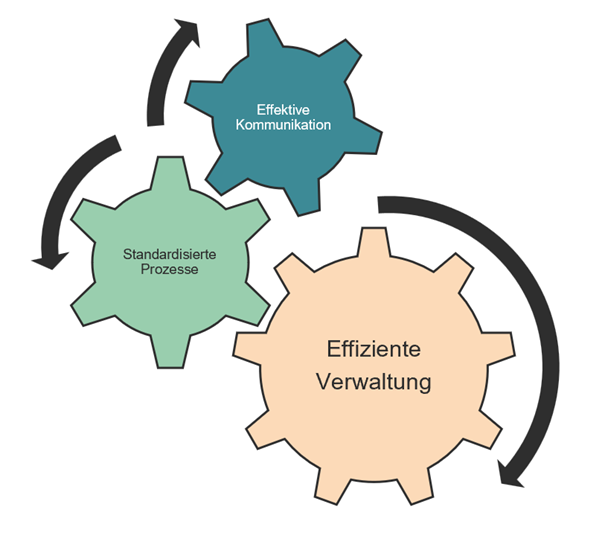
The system combines flexibility with standardisation. Flexibility is achieved through modular text components and parameterisable rules that can be adapted to different funding contexts. Standardisation results from a uniform structure, consistent review logic, and traceable documentation. In operational practice, these features reduce the need for clarifications, shorten approval cycles, and enhance coordination among all involved actors – from specialist departments and ministries to applicants.
The advantages are multifaceted. Specialist departments benefit from reduced workload in recurring legal reviews, while IT units profit from a modular, scalable architecture with open interfaces. Overall, the predictability and effectiveness of funding programmes increase – particularly within the framework of time-sensitive EU funding cycles.
Methodologically, the project integrates process mapping, legal design, and agile software development. Process mapping identifies procedural bottlenecks, legal design ensures clarity and accessibility of language, and agile prototyping enables continuous, practice-oriented optimisation. As an open-source solution, the application can be further developed and adapted to emerging administrative needs.
Furthermore, the tool is not limited to funding guidelines, but can be applied to numerous areas of administration. Whether statutes, notices or guidelines – wherever legal texts need to be standardised and applied flexibly, the generator offers a sustainable solution.
The funding guideline generator makes administration easier, faster and more user-friendly. It is a step towards modern, digital and adaptive administration.
At a glance:
Creation of funding guidelines automated, standardised and comprehensible using AI.
The semi-automated guideline proposals are to be reviewed and approved by legal experts – this is how we combine efficiency with legal validity.
Not limited to funding guidelines, but transferable to statutes, notices or guidelines – the standardisation of legal texts for administrative procedures.
Contact
For suggestions, inquiries and collaboration requests, please get in touch at:
Große Steinstraße 79/80
06108 Halle (Saale)
| legaltech@jtc.uni-halle.de |