Burgenlandkreis
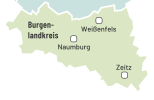
Located at the southernmost tip of Saxony-Anhalt, directly bordering Thuringia and Saxony, Burgenlandkreis combines scenic beauty with an industrial heritage. While the western part of the district is predominantly rural and particularly attractive to tourists due to its wine regions in the Saale-Unstrut area, the eastern part is still shaped economically and socially by mining and its long-term effects. These contrasts make the district diverse – while also presenting it with unique challenges.
Low acceptance of political decisions: Many citizens feel insufficiently involved – political processes are perceived as lacking transparency or being difficult to understand.
Land-use conflicts: Competition between new commercial developments and existing agricultural use increasingly leads to conflicts over land use.
Imbalance in funding allocation: Funding programs from the federal government, the state, and the EU often do not reach medium-sized businesses – there is a lack of targeted support for smaller companies.
Labor market under pressure: With an unemployment rate of 7.4 % (6,567 people) and only 1,186 registered job openings, the regional labor market is strained. (As of August 2025)
Outmigration of young people: Many young people leave the district – either for education, university, or due to a lack of local opportunities.
Reduction in public services: Shortages of skilled workers in healthcare, a lack of teachers, and the decline of cultural offerings exacerbate the quality of life in rural areas.
To make the region sustainable for the future, targeted measures are needed in several key areas:
Support for small and medium-sized enterprises during structural change – through consulting, access to funding, and innovation promotion.
Strengthening regional development and economic promotion.
Improvement of public services, particularly in healthcare (specialist doctors), education (teachers), and basic cultural provision.
Promotion of ecological projects within the framework of structural change – the share of such measures is currently low.
Addressing high vacancy rates – development of new usage concepts for empty apartments and buildings.
Expansion of modern infrastructure: This includes future-oriented mobility concepts, comprehensive digital infrastructure, and connection to the hydrogen network.
JTC Projects in the Burgenlandkreis Region
- Cooperation agreement with Infra Zeitz GmbH – development of bio-based binders.
- Collaboration / cooperation agreement with the Climate Protection Manager of the city of Zeitz.
- Research: Perception of old industrial buildings, e.g., Zitza Zeitz.
- Research: Engagement in structural change – development of an exhibition titled “Women in Structural Change.”
- Research and education for children, youth, and adults (BBI Educational and Consulting Institute GmbH Zeitz).