
Good Neighbourhood Relations for Safe Coexistence in Diversity: Team A6 at the Prevention Day of the City of Halle (Saale)
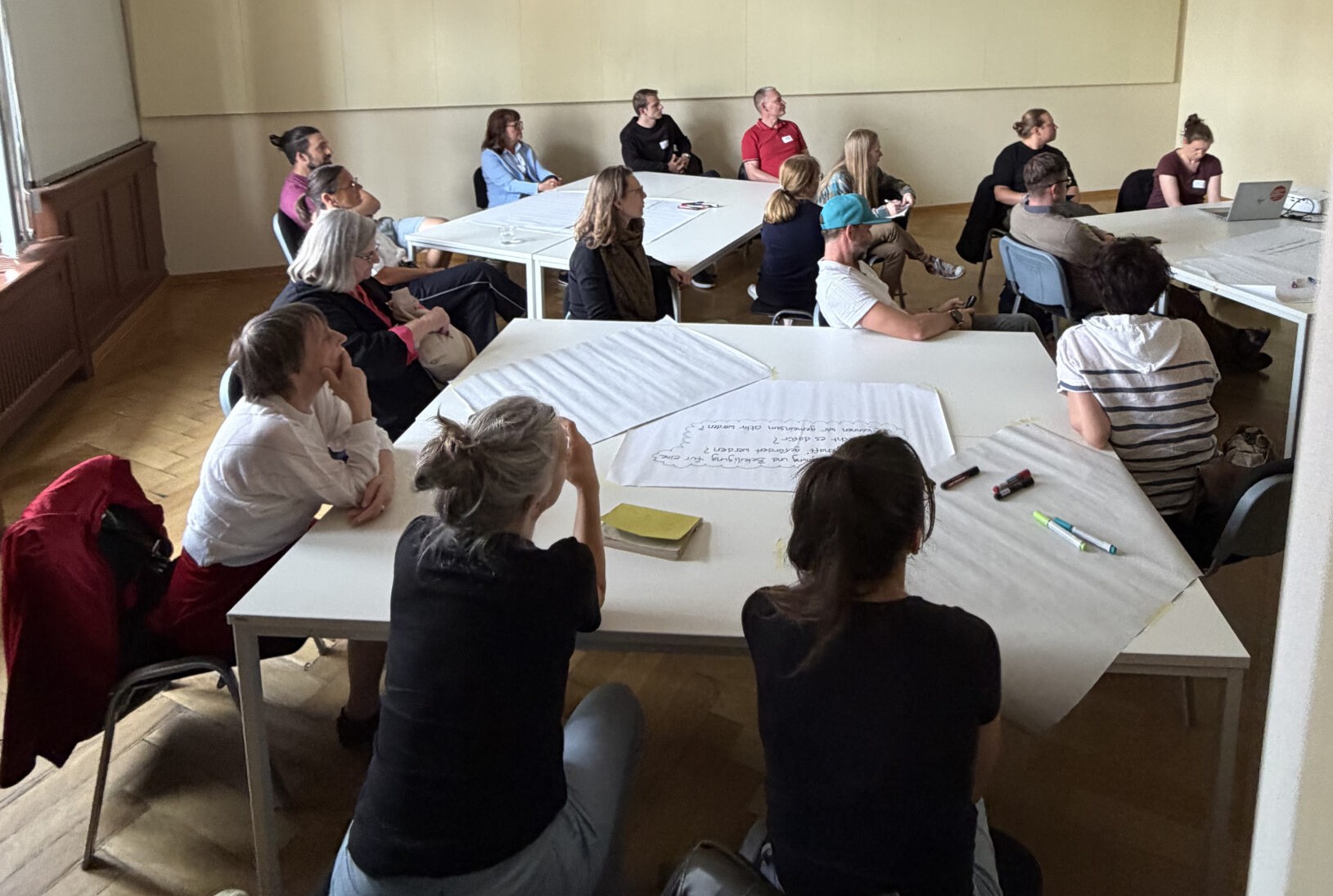
On 11 June 2026, Team A6 of the Just Transition Center participated in the 2nd Prevention Day of the City of Halle (Saale) with a workshop. The workshop, titled “How Does Neighbourhood Become Part of Municipal Crime Prevention?”, brought together representatives of independent organisations, civil society initiatives and municipal institutions from across the city. It was conducted jointly with Johanna Ludwig, project manager of the Halle-Neustadt Neighbourhood Management Office.
The workshop focused on the question of what role good neighbourhood relations play in ensuring safe and solidaristic coexistence in the city. Its aim was to make different perspectives on neighbourhood visible and to jointly discuss how encounters and social cohesion can be strengthened in urban districts.
At the beginning, Johanna Ludwig presented the work of the Halle-Neustadt Neighbourhood Management Office and shared insights from her many years of experience in promoting neighbourhood engagement and local participation processes. Using concrete examples, she illustrated the role that meeting places, joint activities and low-threshold opportunities for participation can play in social coexistence within a neighbourhood.
Afterwards, Marina Rottmann and Lukas Petersohn from Team A6 moderated a workshop in a World Café format. The participants discussed questions such as:
- What challenges currently shape neighbourhood coexistence? How can encounters and participation be promoted?
- What is needed for people to identify with their district and take responsibility for their surroundings?
- And what contribution can good neighbourhood relations make to safety and social cohesion?
The discussions made clear that meeting places and low-threshold participation formats are key for vibrant neighbourhoods. The participants emphasised that trust and the willingness to support one another are fostered primarily through personal encounters which can strengthen the sense of safety in the residential environment. It was also highlighted that identification with one’s own district provides a basis for promoting engagement and a willingness to take responsibility for the community. In addition, the importance of communication and participation formats tailored to specific target groups was emphasised, particularly formats that reach people of different generations and backgrounds. At the same time, the participants pointed to the need for a city-wide perspective in order to strengthen social participation and prevention work in all districts over the long term.
The workshop built on Team A6’s research on diversity and civil society engagement in the context of current socio-ecological transformation processes. It provided an opportunity to bring scientific perspectives into productive dialogue with practical experiences from administration, civil society and neighbourhood work. The Prevention Day was organised by the City of Halle (Saale). Since 2026, Dr Larissa Fleischmann, teamleader of Team A6, has served as an elected member of the steering group of the Prevention Council of the City of Halle.
Dr. Larissa Fleischmann, Marina Rottmann
(Team A6: Diversity in Socio-Ecological Transformations: Migration, Demographic Change, Environmental Conservation)