Places: Kulturkirche (“Cultural Church”) Greppin and Chemical Park Bitterfeld-Wolfen
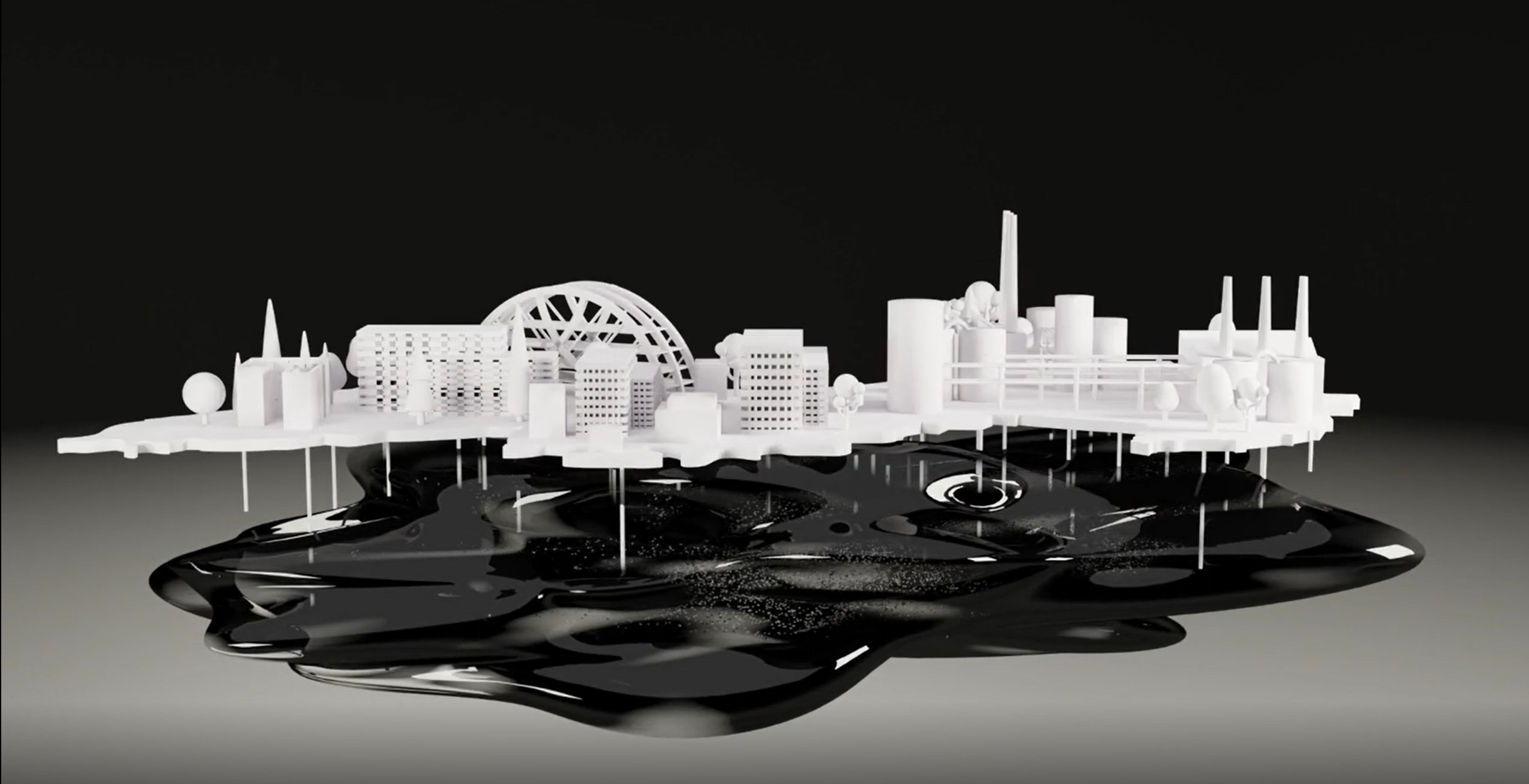
Unmoved by speeches and writings, the “Bitterfeld Blob” lies in a state of monstrous unrest beneath the town and the chemical park. An inverted, underground monument. A so-called “burden for eternity” and a task for generations to come. Only continuous pumping and filtering prevent the spread of its toxins. What exactly is the “Bitterfeld Blob”, and how can it be understood? And what if we were to take the care work carried out by the pumps and their guardians as models for a new way of preserving industrial heritage?
Our activity began with a presentation at the Kulturkirche Greppin. We showed and explained the “Bitterfeld Blob” projection by the artist and Burg Giebichenstein graduate Thea Kleinhempel, which was positioned centrally above the visitors’ heads in the crossing of the nave. Despite the chilly, rainy weather, a pleasingly large number of visitors had turned up – around 80 people – including many residents of Greppin, as well as Christian Dorausch, project manager at MDSE, the company responsible for contaminated site management, and Evelyn Schaffranka, deputy managing director and project manager at the Saxony-Anhalt State Agency for Contaminated Site Remediation (LAF), the authority responsible for these processes and for providing the necessary funding. In the meantime, Thies Schröder, Managing Director of Ferropolis and one of the coordinators of the Industrial Heritage Network, also honoured us with his presence and spontaneously addressed the audience with a few words. We were a little nervous as to how the professionals would react to the artistic presentation we had commissioned for this event and to our approach.
Background and motivation for us was the question as to what it might mean to regard a contaminated site as a monument to industrial heritage. What sort of “heritage conservation” would it require? Since the chemically contaminated soil cannot be remediated for the time being, and the environment cannot be definitively “cleared” of the contaminated site – as the officialese puts it – pumps operate ceaselessly, preventing the groundwater flowing through them from carrying its chemical load into the adjacent Mulde river system. We regard the work of the MDSE’s pump attendants, who continuously monitor and maintain the well barrier, as a paradigmatic act of care, as required by life on a damaged planet. Unlike previous ‘non-specialist’ engagements with the contaminated site, which focused on sensationalising its existence and scale, we wanted to take a constructive look and highlight the significance of this monitoring and care work.
But how can one conceive of something as a monument when it is highly dynamic and lacks a consistent form? At the start of the chain of associations we used to spark Thea Kleinhempel’s interest in the project was the image of the bubble as a sort of inverted Buckminster Fuller dome. Unlike the famous 1959 “Dome over Manhattan” design, it is not erected as a utopian, transparent structure above the city, but rather – as a negative image inverted into the dystopian – spans beneath the city and the chemical park.
Furthermore, it is of paramount importance to understand that the pumps, too, form part of the monument. Without them, not only would the adjacent ecosystems be doomed due to the sometimes extremely high toxic concentrations in the soil. Without the many probes and pumps, and the knowledge accumulated through them and human analytical work, the “Bitterfeld Blob” as such could not even be described – or artistically represented. Perhaps there is no comparable site of contamination anywhere in the world whose composition, spatial distribution and consistency are known with such precision. To take this line of thought a step further, what we are dealing with here is a particularly extreme manifestation of a fateful body of knowledge typical of industrial modernity: It is precisely in the most destructive undertakings – in oil exploration and coal mining, in extractivist ventures of all kinds, in massive environmental damage such as oil tanker accidents, reactor disasters, chemical accidents, and the analysis of their consequences – that the greatest body of knowledge is accumulated regarding geological history, Earth system dynamics, and geo-bio-chemical interrelationships.
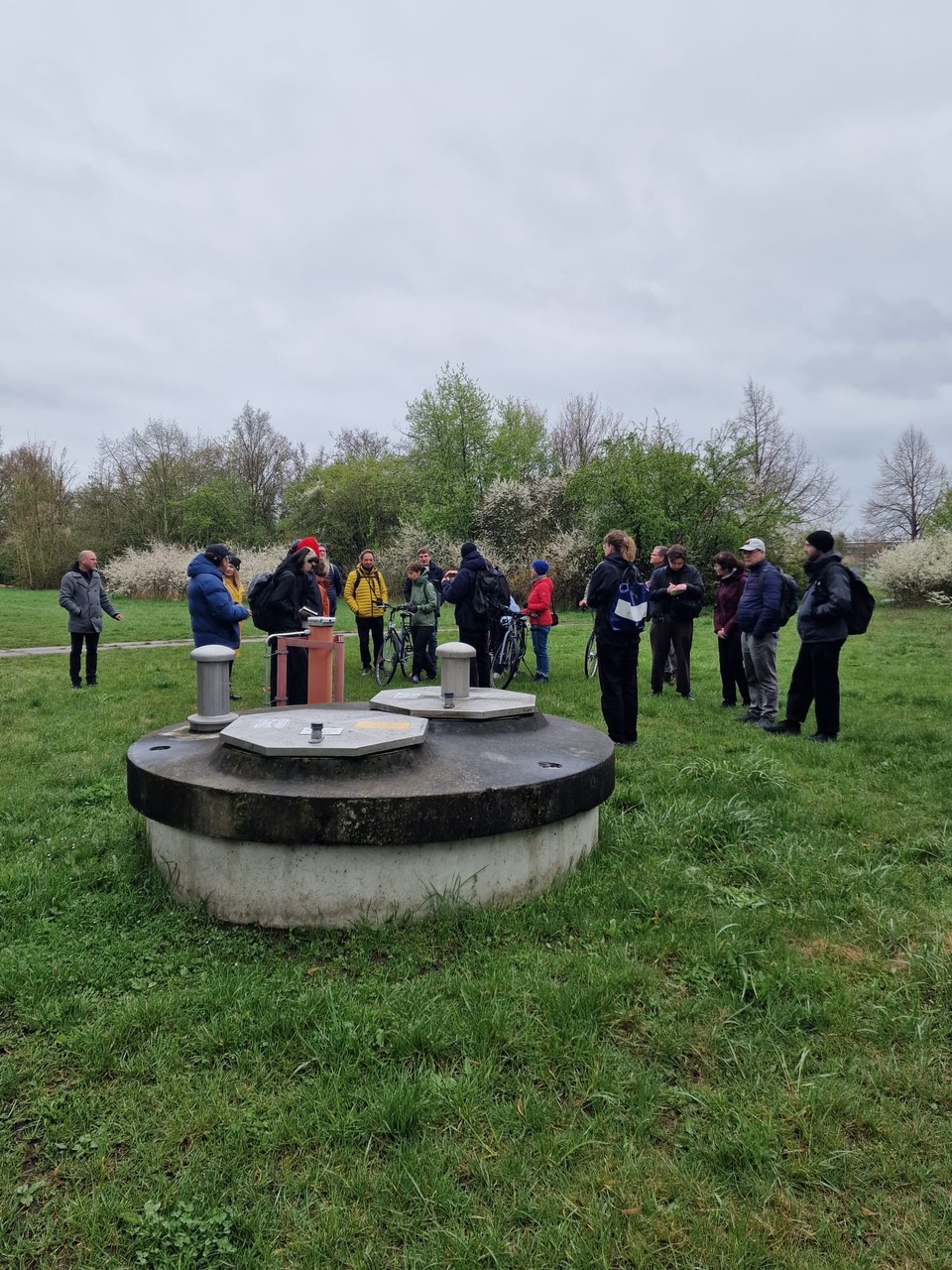
Our worries proved to be unfounded. The blob animation went down very well. The colleagues from MDSE and LAF accompanied us on the roughly three-hour walk through the surprisingly diverse landscape of the chemical park, following the Bitterfeld Wellfield Barrier from Greppin to Wolfen. Much to the delight of the locals who joined us, who asked the experts many questions. We had organised the walk to gain a shared understanding of the density and spatial distribution of the network of soil, water, chemicals, probes, pumps and the people who operate them – the network that constitutes the “Bitterfeld Blob” – and to anchor this understanding in a physical experience.
Our journey came to an end on the outskirts of Wolfen, behind the Fuhneaue, where two new wells have just been installed to intercept a particularly highly concentrated pocket of contaminated soil which, like a meteorite travelling in slow motion, is on a deviant course away from the managed contaminated site. We would like to thank the team at the Kulturkirche Greppin for their professional work in setting up the video installation and for their fantastic support.
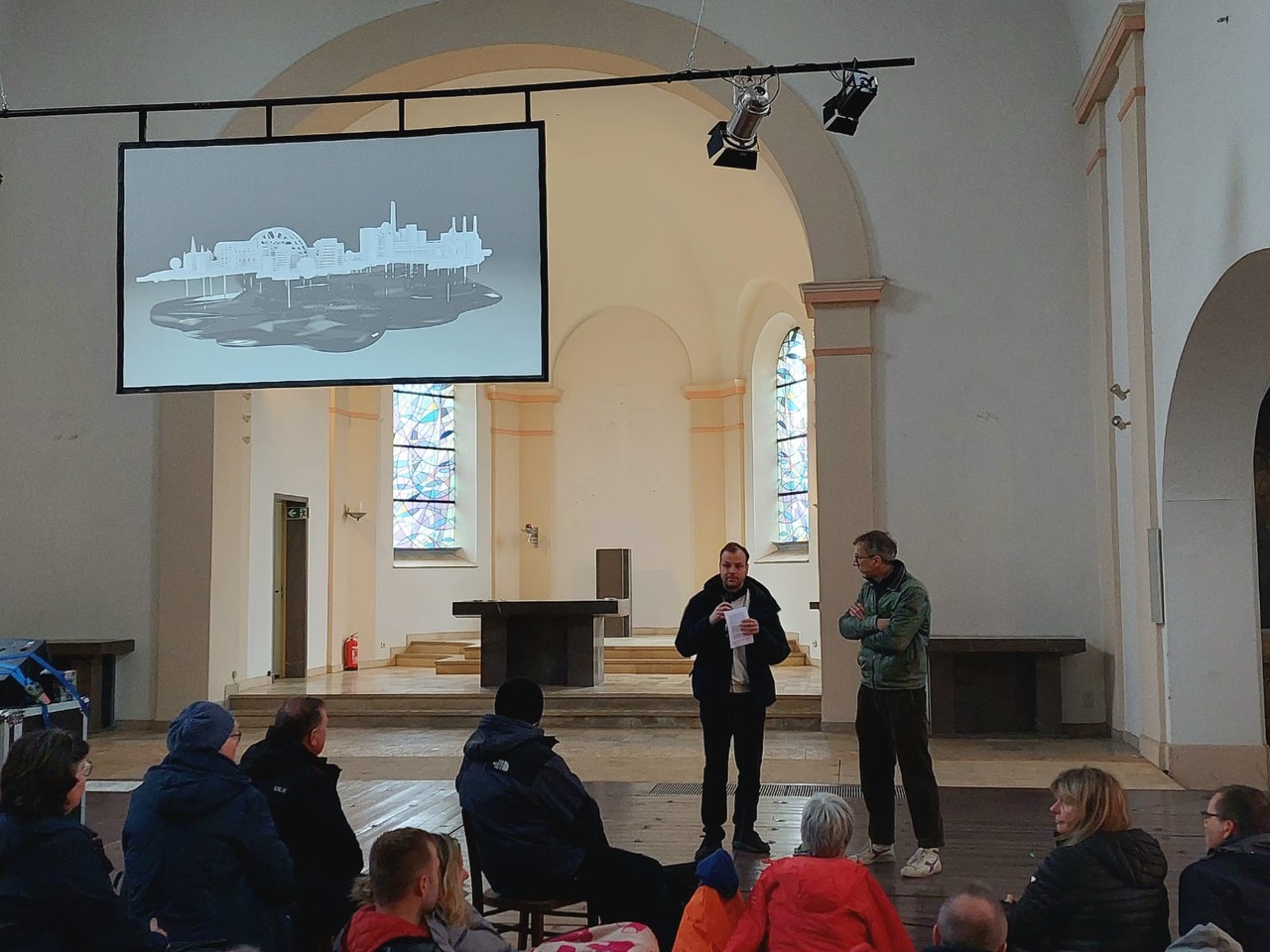
Kulturkirche Greppin_Felicitas Faessler